

25 February 2026
There are several benefits that make biomethane especially attractive, but the most important include its ability to: deliver material lifecycle greenhouse gas savings, often around 50–70% versus natural gas, (with actual performance dependent on factors such as feedstock choice, plant design and methane emissions management); operate through existing infrastructure and appliances; provide a proven and reliable low-carbon fuel, with recent 2025 UK analysis estimating the average net levelised cost of biomethane projects today is around £90/MWh (noting this varies by feedstock, scale and revenue stack); support the circular economy by converting organic waste into renewable energy while returning nutrients to the soil.
Yet, despite all these benefits, and with the UK history of biomethane use going all the way back to 1895, where gas from sewage sludge was used to power streetlamps in Exeter, wider biomethane adoption has been slow. In 2025 only around 7 TWh of biomethane was injected into the UK gas grid according to National Gas and Cadent. This is equal to around 1% of the 743 TWh of natural gas consumed in the UK in 2024.
So why has biomethane adoption been slow in the UK despite its proven potential for decarbonising the gas grid? To answer this question, we first need to understand the current policy and regulatory landscape governing biomethane production and injection in the UK.
The UK biomethane regulatory landscape
You can find out more on our dedicated biomethane webpage, but some of the core elements include:
- Financial support – This is currently provided through the Green Gas Support Scheme (GGSS), funded by the Green Gas Levy, with longer-term arrangements expected under the forthcoming Future Biomethane Policy Framework; producers can also access the Renewable Transport Fuel Obligation (RTFO) when supplying the transport sector.
- Connections – Projects typically connect to local gas distribution networks and bear most connection and reinforcement costs.
- Gas regulation – Biomethane must comply with gas quality regulations originally designed for fossil gas, often requiring propane blending to meet calorific standards, adding around £4/MWh and increasing emissions, based on the Green Gas Taskforce’s Green Gas Britain report 2025.
- Additional regulations – Biomethane projects must also navigate local planning processes, environmental permitting, and digestate regulations alongside multiple sustainability and reporting requirements across different markets.
Overall, the UK approach to biomethane is characterised by targeted policy support within a broader regulatory landscape not originally designed for renewable gas. While this stopgap has enabled small scale deployment of biomethane, the remaining policy barriers prevent wider implementation. This indicates an opportunity for a more coordinated and comprehensive biomethane strategy to rapidly accelerate the rollout of biomethane, reducing UK carbon emissions at minimal cost to households and businesses.
What our neighbours are doing
The UK has the opportunity to learn from the success of our European neighbours. Denmark – a world leader in biomethane – has adopted a highly supportive regulatory and policy framework with biomethane accounting for around one third of all gas used in 2023-2024. The Danes also have a goal of 100% green gas consumption by 2035.
A key element to this success has been the early long-term commitments that were made by the Danish government. As early as 2009 the government planned to have 20% of its energy produced from biogas by 2020. In 2012 Denmark’s Energy Agreement changed the rules so that biogas upgraded to biomethane and sold into the natural gas grid received the same subsidy as biogas used in CHP plants, making it financially viable to upgrade biogas for use in the gas network. The agreement also resulted in the creation of a Biogas Taskforce with the goals to help implement the expansion targets for biogas, coordinate development and address industry barriers, and monitor progress toward the planned increase in biogas up to 2020.
Crucially, Denmark took the decisive step to update its gas quality rules to ensure that upgraded biogas is accepted into its gas grid. The permitted energy content ranges are already optimised for biomethane, with rules explicitly allowing small volumes of oxygen and other common components of renewable gas. As a result, biomethane can usually be injected without adding propane to boost calorific value, making grid connection simpler and cheaper.
Sweden and Finland have similarly combined long-term targets with supportive frameworks. In Sweden, the government has set a goal for gas used across all sectors of the economy to be renewable by 2045 and provides both investment grants and feed-in premiums to incentivise production, while streamlined permitting procedures reduce project development delays. Finland has implemented fixed-volume feed-in tariffs for biomethane, combined with guarantees of origin that enable producers to access multiple markets and incentivise additional supply. Both countries also integrate biomethane into transport fuel obligations, creating consistent demand signals that encourage investment.
France has accelerated biomethane adoption through a statutory “right to inject” introduced in 2018, which guarantees network access for producers located near a gas network and requires grid operators to cover up to 60 percent of eligible grid connection costs, subject to a cap of €600,000 per project. This policy significantly lowers upfront financial barriers to biomethane implementation. When combined with coordinated grid zoning – whereby network operators plan injection zones based on local grid capacity and forecast biomethane production potential – and regulated injection tariffs, these regulations ensure both procedural clarity and predictable operational costs. By minimising network uncertainty and connection liabilities, these measures have made France one of the leading EU countries for biomethane deployment.
Germany relies heavily on market-based mechanisms within a structured regulatory framework. Auctions and market premiums under the Renewable Energy Sources Act incentivise biomethane production while ensuring competitive deployment. Regulatory certainty is provided through the Gas Grid Access Ordinance, which obliges network operators to facilitate grid entry. Germany also benefits from integrating biomethane into wholesale gas markets, allowing injected biomethane to be traded without additional segregation, enhancing market liquidity. Where necessary to comply with gas quality standards (including calorific value and Wobbe index limits), biomethane is conditioned prior to injection, potentially including propanation, to ensure full interchangeability with natural gas in the H-gas grid.
The Netherlands has taken a hybrid approach, combining fiscal incentives and mandatory blending. The SDE++ subsidy scheme compensates producers for the cost difference between renewable gas and fossil alternatives, while the Green Gas Blending Obligation mandates renewable gas inclusion in heating and industrial supplies. These measures create both financial viability and guaranteed market demand, driving rapid adoption.
Learning from success
Across these leading EU countries, a clear pattern emerges of early strategic planning, long-term targets, predictable financial incentives, regulatory alignment with gas grid requirements, and demand-side measures such as blending obligations or transport fuel mandates as being key policy tools to accelerating biomethane deployment. These policies reduce both investment risk and operational barriers, providing certainty to producers, network operators, and end-users, resulting in significantly higher biomethane adoption in these countries compared to the UK.
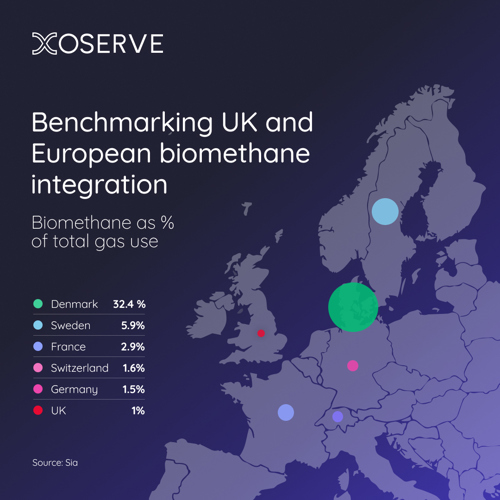
In contrast, the UK’s current approach is characterised by shorter-term schemes and fragmented regulations. But by drawing key lessons from its neighbours, the UK has the opportunity to rapidly accelerate biomethane adoption, for example we could:
- Set medium and long-term production targets – Establish clear national biomethane targets for 2030 and 2040, similar to Denmark’s early 2009 and 2012 strategic commitments, to provide market certainty for developers and investors.
- Introduce guaranteed demand mechanisms – Implement blending obligations for heating networks or industrial gas supply, or expand transport fuel mandates, following the Dutch Green Gas Blending Obligation and Sweden/Finland’s integration of biomethane into transport.
- Reform gas quality standards – Align calorific value and gas composition rules with biomethane characteristics to reduce the requirement for propane enrichment. As seen in Denmark’s updated gas quality regulations, this can facilitate reduced operational costs of biomethane production and injection.
- Redistribute network connection costs – Share or cap connection and reinforcement costs through a revised regulatory framework that redefines upfront exposure for individual projects via regulated charging arrangements, helping to accelerate grid injection.
- Establish strategic oversight and coordination – Create a central taskforce or advisory body, akin to Denmark’s Biogas Taskforce, to monitor deployment, coordinate development, and address regulatory and industry barriers.
- Streamlined permitting – Integrate permitting processes for network connection, digestate use, and environmental compliance to shorten project development timelines.
By combining these measures, the UK has the opportunity to surge ahead with rapid, reliable and cost-effective decarbonisation of the energy system through a coherent, long-term framework for biomethane.
Get in touch
Learn more about biomethane and the role it can play in decarbonising the gas grid on our dedicated biomethane pillar page.
If you have any feedback or questions on any of the above, please email us at decarbonisation@xoserve.com.
Share this news article